
When Avowed finally arrived in early 2025, it did more than give Obsidian fans a new corner of Eora to explore. It also became an unlikely stress test for one of gaming's strangest economies. Microsoft had placed the game on Battle.net, Blizzard's own launcher, alongside World of Warcraft, Overwatch, and Diablo. That alone was notable. What made it stranger was the quiet implication: a player could, in theory, buy Avowed with World of Warcraft gold.
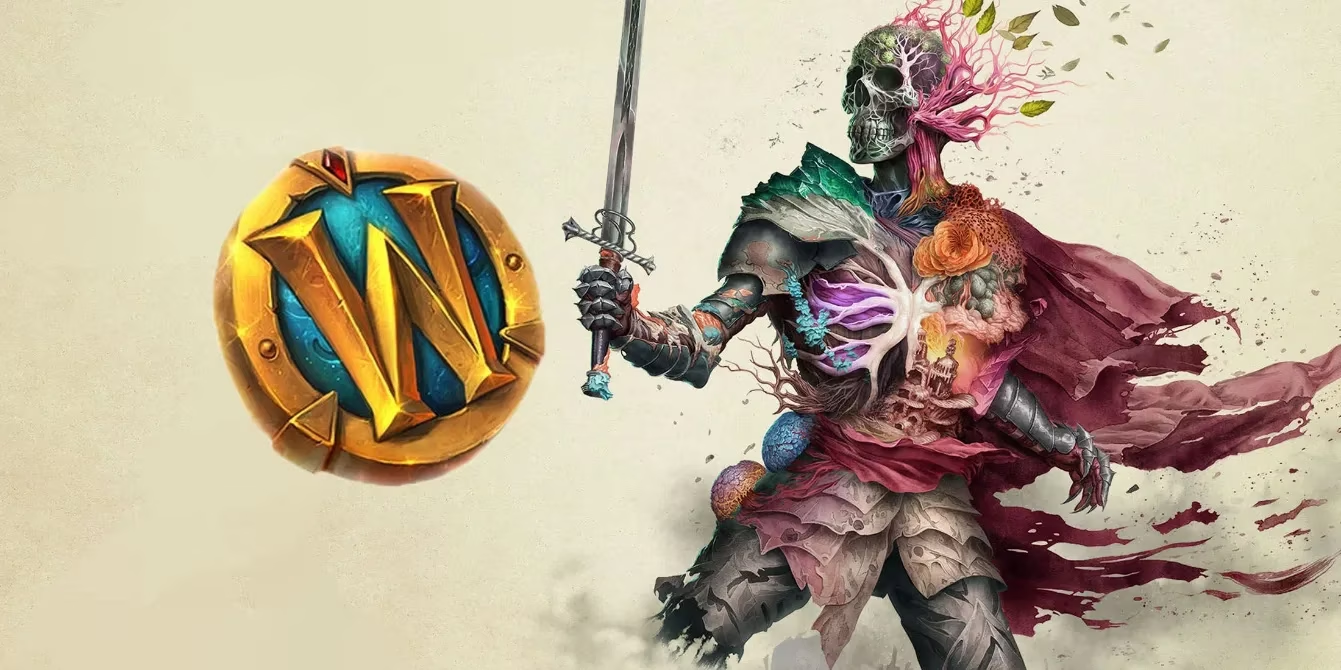
The method worked through WoW Tokens. A player buys a token from Battle.net for $20 and lists it on World of Warcraft's Auction House. Another player buys it with gold, then redeems it for roughly $15 in Battle.net credit. That credit can be spent on games in the Blizzard ecosystem. So the circle closes: gold becomes balance, balance becomes Avowed. It sounds like a magic trick, and in some ways it is.
This was not entirely new. Blizzard had long allowed its library to be purchased through Battle.net credit, and WoW Tokens had been convertible for years. But Avowed was different. It was not an Activision Blizzard game. It was an Obsidian Entertainment title published by Xbox Game Studios, and its appearance on Battle.net marked a rare crossover. For Microsoft, that crossover looked like a deliberate experiment.
By 2026, the experiment has not been forgotten. Avowed is no longer an upcoming release; it is part of the platform's catalog. Yet the conversation around its purchase path remains alive because it exposes a bizarre intersection of virtual economies, platform strategy, and player psychology. Microsoft has been pushing games across more devices and storefronts, and Battle.net may be more than a legacy launcher. It could be a future PC storefront with real reach. Avowed was the test case.
The problem is that WoW Tokens are not a stable currency. Their gold prices swing wildly by region, server, and season. At one point, a single token in some regions climbed to half a million gold. In the US market, buying Avowed with gold required over a million gold. Those numbers are not fixed. They shift with supply, demand, and whatever Blizzard has recently added to World of Warcraft.
That volatility makes the idea of buying Avowed with gold both fascinating and impractical. A player who starts saving might find the price has doubled by the time they reach the Auction House. A player who buys tokens as an investment might watch their value collapse after a major content drop. The market is not a simple store shelf. It is a living, breathing auction hall with its own speculators, farmers, and panic cycles.
| Factor | Effect on Avowed's gold price |
|---|---|
| Regional token prices | Creates wildly different costs across NA, EU, and Asia |
| WoW content updates | Can drain or flood the Auction House with tokens |
| Player demand for Avowed | May push more players to buy tokens with gold |
| Battle.net credit value | Ties the whole system back to real-money store credit |
The Trader's Gilded Brutosaur incident showed how fragile this ecosystem can be. When Blizzard announced the highly desirable mount, the Auction House was drained of WoW Tokens almost overnight. Players rushed to convert real money into gold, and the token supply vanished. If a single mount can cause that much chaos, a full game release on Battle.net could do even more. Avowed may not appeal to every WoW player, but it appeals to a certain kind of RPG fan, and those fans overlap heavily with Warcraft's audience.
That overlap is exactly why Microsoft may be watching closely. If Avowed sells well through Battle.net, other non-Activision games could follow. If it causes token prices to spike or crash, Microsoft may learn that mixing game currencies with store credit is riskier than it looks. Either way, the data is valuable.
Blizzard has spent years turning WoW Tokens into a legitimate bridge between real money and in-game wealth. The system is clever, but it is also fragile. It depends on players trusting that tokens will retain value. It depends on the Auction House remaining liquid. It depends on Blizzard resisting the urge to flood the market with incentives. Adding full games to the redemption pool changes the calculus. Suddenly, WoW gold is not just for mounts, boosts, or subscriptions. It is a way to buy a completely different game.
That shift could encourage other platforms to try similar models. Imagine a future where Sony, Microsoft, and Nintendo all allow their in-game currencies to convert into store credit. Imagine competing currencies on the same launcher. The idea sounds absurd until one remembers that WoW Tokens already made it real. The slippery slope is not just theoretical; it is a short walk from here.
Not everyone is convinced that disaster is coming. Avowed may be only mildly interesting to the most invested WoW players. Many of them already have plenty of games and little reason to spend gold on an Obsidian RPG. The token market might absorb the change without a tremor. In that case, Microsoft gets a quiet win and a proof of concept. Battle.net becomes a slightly more legitimate general PC storefront, and players get another way to buy games.
Still, skepticism remains. Fans have watched Blizzard and Microsoft make strange platform decisions before. They have seen economies bend under cosmetic promotions and limited-time events. They know that virtual currencies are never as simple as they appear. Avowed's presence on Battle.net is a small detail in a large strategy, but it is a revealing one.
In 2026, the question is no longer whether Avowed can be bought with WoW gold. It can. The real question is what that means for the future. If Microsoft is testing Battle.net as a broader PC marketplace, then WoW Tokens may become a template for something bigger. If the experiment fails, it will be a curious footnote in the history of cross-platform publishing. Either way, Avowed will be remembered for more than its combat and exploration. It will be remembered as the game that let Warcraft gold buy a trip to the Living Lands.
Comments