
There’s a moment early on in Avowed where the Emerald Stair gives way to the port town of Paradis, and the first thing that hits you isn't the salty air or the distant cry of gulls—it's a pair of broad shoulders and a grin that seems entirely too easy for a world collapsing into the Dreamscourge. That grin belonged to Kai. I met him in 2025, when Obsidian’s action RPG first released, but even today in 2026, his voice and presence are carved into my memory. He was my first companion, my shield, and the friend I didn’t know I needed.
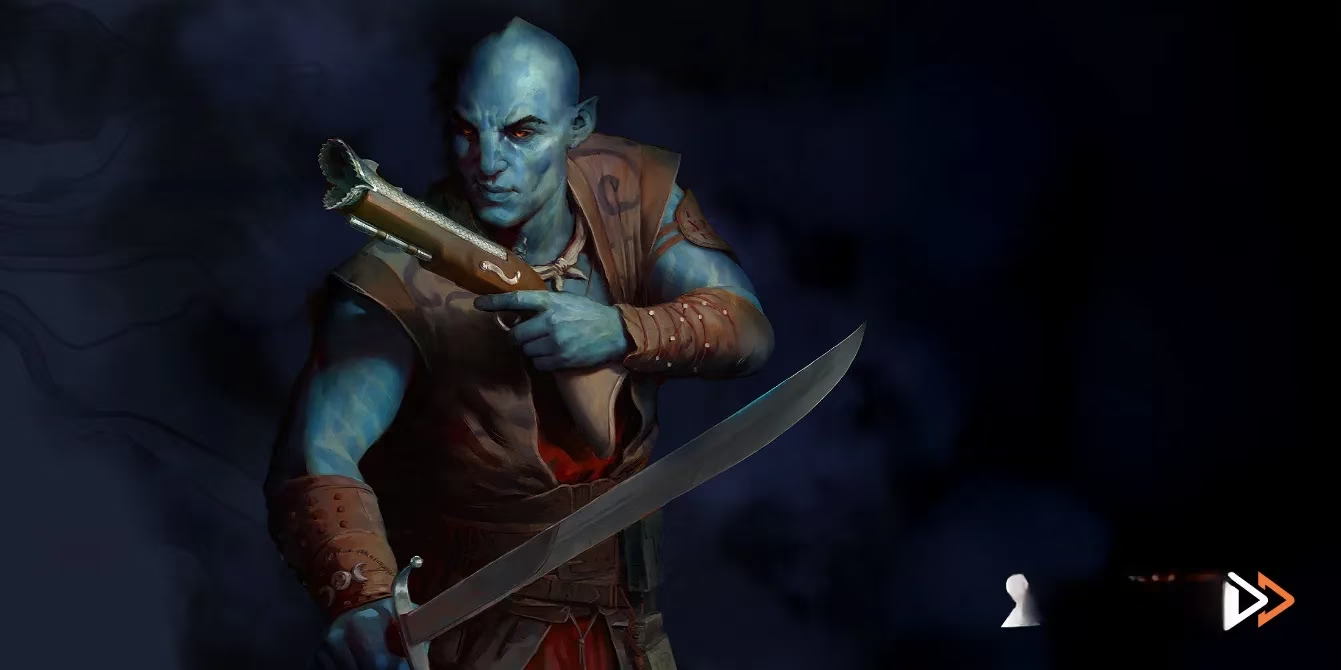
Kai isn’t just any sidekick. He’s a coastal aumaua, a towering figure whose skin bears the calluses of a soldier and whose eyes hold the ghosts of the Deadfire Archipelago. When I first heard his voice—brought to life by Brandon Keener, the man behind Garrus Vakarian—I felt an immediate pull. That warm, gravelly tone promised both a quick joke and deep loyalty. In battle, he was my rock. I’d watch him charge into a pack of xaurips, fire licking off his blade, taunting them away from Giatta who was frantically trying to cast a healing spell. He’d go down, then rise again with a grunt and half his health, ready for more. That’s Kai: a tank who doesn’t just take hits, but who makes you believe you can survive.
But tanks are a dime a dozen. What kept me sitting beside his bedroll at camp every night was the man behind the brawn. On the surface, Kai is the class clown of Avowed’s four companions. He’ll crack a joke when Yatzli’s magic fizzles, tease Marius about his broodier moments, and always find a kind word for the Envoy—me—when the weight of the Dreamscourge grew heavy. Yet every quip felt like a curtain drawn over something deeper. I remember one evening in the Emerald Stair region. We’d just fought off a wave of plagued beasts, and as the others collapsed, Kai was already kindling the fire. I asked him why he never seemed tired. He laughed, said something about Rauataian rum and stubbornness, but the pause before the deflection told me more than words.
That pause, I later learned, was the echo of his past. Kai was a soldier in the Rauataian Navy. He fought in the Deadfire, saw horrors he still won’t name, and chose to desert. The why remains a scar he doesn’t show, but you feel it. Game director Carrie Patel, who also wrote Kai, once said in an interview that his humor emerged as both good company for players and a mask for real vulnerability. I saw that mask slip only a handful of times—once when we stumbled upon an old naval outpost, its flag still tattered, and once when he spoke of a friend left behind. In those moments, Kai wasn’t a companion; he was a brother with a crack in his armor, letting me see the regret and heartache he carried.
Spending dozens of hours with Kai meant uncovering those layers at my own pace. He was always ready to burn down a bramble wall or leap into a river to save a drowning settler, and those small acts of kindness made me want to dig deeper. I’d spend extra time at camp just listening. He’d tell me about his six years as a mercenary, about the Living Lands’ port cities, about the way the sea smelled back home. All the while, his affability was a steady hand on my shoulder—but I never forgot that it was also a shield. A shield forged from pain.
Mechanically, I came to rely on Kai’s fire abilities more than I expected. Beyond combat, his flames cleared paths, unlocked secrets, and even revealed hidden caves. I’d point, he’d ignite, and the world would open. It mirrored our relationship: I pointed at a piece of his past, and he’d carefully burn away the obstructions, just enough to let me through. There’s a specific dungeon in the Shattered Straits where only his fire could destroy a cursed briar. As the vines turned to ash and the path ahead glowed, he turned to me and said, “You’d be stuck in a whole lot of brambles without me, Envoy.” I laughed. I needed that.
What makes Kai truly remarkable in 2026’s landscape of RPG companions is his refusal to be a one-note archetype. He’s not just the loyal tank with a heart of gold, nor simply a traumatized soldier seeking redemption. He’s both, and neither, all at once. His backstory, meticulously expanded by the writing team, bleeds into every decision. When we encountered other Rauataian mercenaries, his voice tightened. When we had to choose between saving a village or chasing a lead on the Dreamscourge, he advocated for the people—not because he was a bleeding heart, but because he’d already abandoned too many.
By the time my Envoy reached the final confrontation, Kai had become more than a companion. He was my touchstone. I’d built a bond that rivaled any I’d formed in other RPGs, and it wasn’t because of grand gestures. It was the quiet moments: a shared drink after a brutal fight, a story about a ship that never sailed, a silence that said more than any scripted dialogue could. And when the credits rolled, I sat there thinking not about the god-like powers I’d unleashed, but about a coastal aumaua who taught me that strength isn’t the absence of weakness—it’s the courage to show it, one joke at a time.
If you’re playing Avowed in 2026 for the first time, or returning for its latest DLC, do yourself a favor: bring Kai everywhere. Speak to him until he has nothing left to hide. Let him burn your obstacles and taunt your enemies. Behind that easy smile and battle-hardened exterior is a character built with extraordinary care, a stalwart brother-in-arms who will make your journey through the Living Lands not just survivable, but unforgettable. He certainly did for me.
Comments